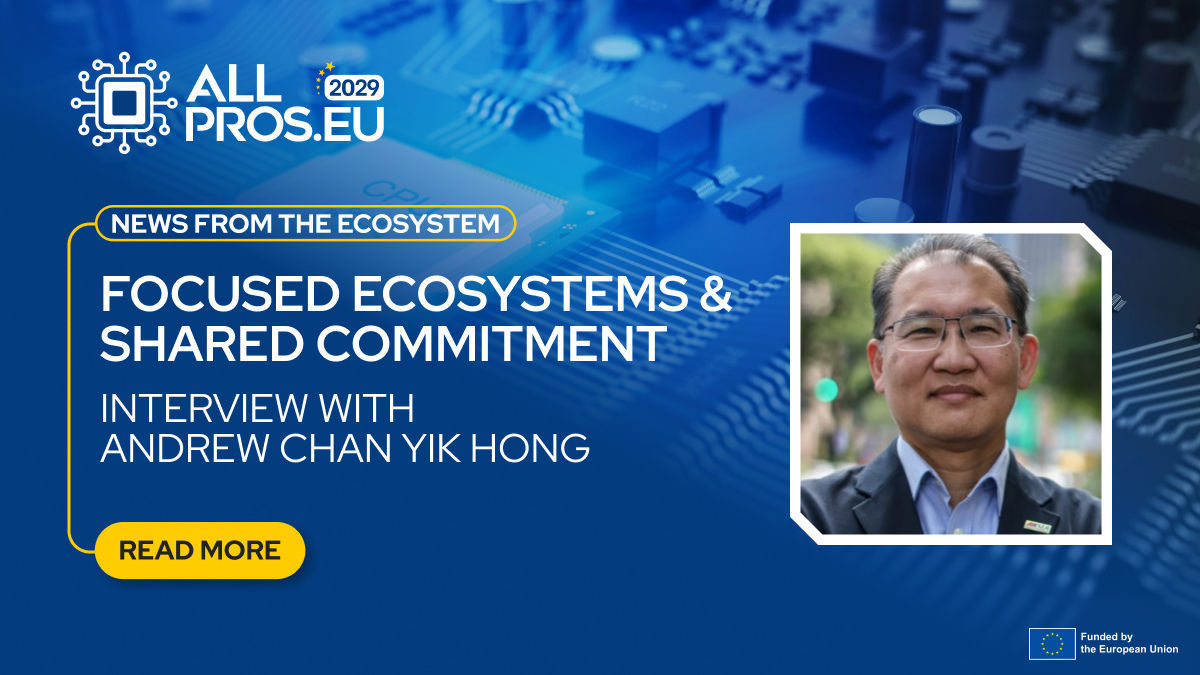
Focused Ecosystems and Shared Commitment: Interview with Andrew Chan Yik Hong
With extensive experience spanning industry leadership, policy engagement and international collaboration, Andrew Chan Yik Hong has long been involved in the evolution of the global semiconductor sector. As former Executive Director of the Malaysia Semiconductor Industry Association (MSIA), he worked at the intersection of industry development, talent strategy and ecosystem building, engaging with stakeholders across the global semiconductor value chain. He also contributed to several national initiatives focused on industrial strategy, skills development and ecosystem growth, while previously holding leadership roles at PwC Consulting, IBM and Gamuda. Today, he writes and speaks on semiconductors, artificial intelligence, industrial policy and global supply chains.
For Mr. Chan Yik Hong, the semiconductor industry has entered a fundamentally new phase. Over the past decade, semiconductors have evolved from a highly specialised sector into the backbone of digital transformation and Artificial Intelligence. Yet for him, the most profound transformation goes beyond technology, because it has reshaped the very architecture of the global semiconductor ecosystem. As he explains it:
The pandemic was a turning point, it forced the industry to rethink supply chains and move from a just-in-time approach to a more resilient, just-in-case model.
The result has been a fundamental rethinking of how value chains are built, where capacity is located, and how nations secure their technological future.
The pandemic exposed vulnerabilities in highly optimised global supply chains, accelerating a transition towards regionalisation and strategic autonomy. At the same time, it brought semiconductors into the public spotlight, transforming what had long been a largely invisible industry into a central pillar of economic and technological policy.
“What used to be an invisible industry is now central to national and regional strategies,” Andrew notes. “Today, semiconductors are about resilience and long-term competitiveness.”
In this context, Europe has significantly strengthened its position, placing semiconductors at the heart of its industrial agenda and reinforcing its ambition for technological sovereignty through initiatives such as the Chips Act.
Malaysia and Europe: complementary strengths in a global chain
Europe enters this new era with a remarkable portfolio of strengths spanning the semiconductor value chain. Countries such as the Netherlands and Germany play a pivotal role, combining global leadership in semiconductor equipment with world-class research ecosystems and industrial champions that continue to drive innovation. In his opinion:
What distinguishes Europe is the extraordinary concentration of expertise across research, engineering and industrial innovation, you have world-class research institutions, strong industrial players, and a clear commitment to long-term innovation.
More importantly, he believes Europe’s competitive advantage lies not only in individual excellence, but in its ability to connect capabilities across borders, disciplines and sectors, transforming expertise into ecosystem-wide impact.
Andrew suggests Malaysia’s position in assembly, testing and packaging offers a natural complement to Europe’s strengths in design, equipment and high-value innovation.
Rather than viewing cooperation as a one-way transfer of knowledge, Mr. Chan Yik Hong describes the relationship as a model of mutual reinforcement, where each region contributes distinct capabilities to a shared value chain.
“It is about complementarity. Europe brings strong innovation and design capabilities, while Malaysia contributes scale and manufacturing efficiency. Together, this creates a more resilient global value chain.” he states.
This interdependence is already reflected in the strategies of global semiconductor companies, many of which distribute activities across regions to combine technological leadership with manufacturing excellence.
For Andrew, this kind of collaboration will become increasingly important as the industry continues to grow in complexity and strategic significance.
"Skin in the Game": Building Partnerships that Last
Across all regions, talent remains one of the most critical enablers of semiconductor growth. Yet Andrew Chan Yik Hong sees this challenge as an opportunity to strengthen cooperation between industry, academia and policy makers. He says:
AI will improve productivity, but it will not replace the need for skilled talent, what is essential is continuous education and strong partnerships across the ecosystem.
He emphasises that Europe is particularly well positioned to lead in this area, thanks to its strong university networks, research institutions and collaborative frameworks that already facilitate knowledge exchange across borders.
Developing talent is a generational investment, one that ultimately determines the resilience, innovation capacity and competitiveness of the entire ecosystem.
As semiconductor technologies become increasingly sophisticated, lifelong learning and closer industry-academia collaboration will be essential to ensure that Europe can continue to develop the expertise required for future growth.
One of the most important lessons that Mr. Chan Yik Hong has drawn from years of international collaboration is that successful partnerships require genuine commitment from all parties involved.
“Partnerships only work when everyone has skin in the game,” he explains. “That means real investment: time, resources and responsibility from all sides.”
For him, trust is built through action rather than ambition alone. While large-scale visions are essential, he believes that meaningful collaboration often begins with smaller initiatives capable of delivering tangible outcomes.
“Quick wins are important,” he adds. “They build trust, and trust is what allows collaboration to scale.”
Looking ahead, Andrew Chan Yik Hong sees a clear strategic direction for Europe: building on existing strengths through focused investment in high-impact areas.
In a world where resources are finite and competition is intensifying, he thinks success will not come from trying to do everything, everywhere, all at once.
Instead, Europe can amplify its global influence by doubling down on the areas where it already enjoys world-class leadership. He concludes:
For Europe, the opportunity is to focus where it already leads, areas like power semiconductors, advanced equipment, and specialised technologies can become global anchors if properly supported.
By concentrating resources on strategically important segments, Europe can maximise impact, accelerate innovation and reinforce its position within the global semiconductor landscape.
The next phase of semiconductor development, he suggests, will be defined by interconnected ecosystems built on trust, complementarity and shared ambition.
“Semiconductors are inherently global,” he concludes. “The future belongs to ecosystems that collaborate with purpose. The stronger those connections become, the stronger the global semiconductor industry will be.”
If you want to contribute to shaping the next chapter of the EU semiconductor future, consider joining the Industrial Alliance for Semiconductors.
