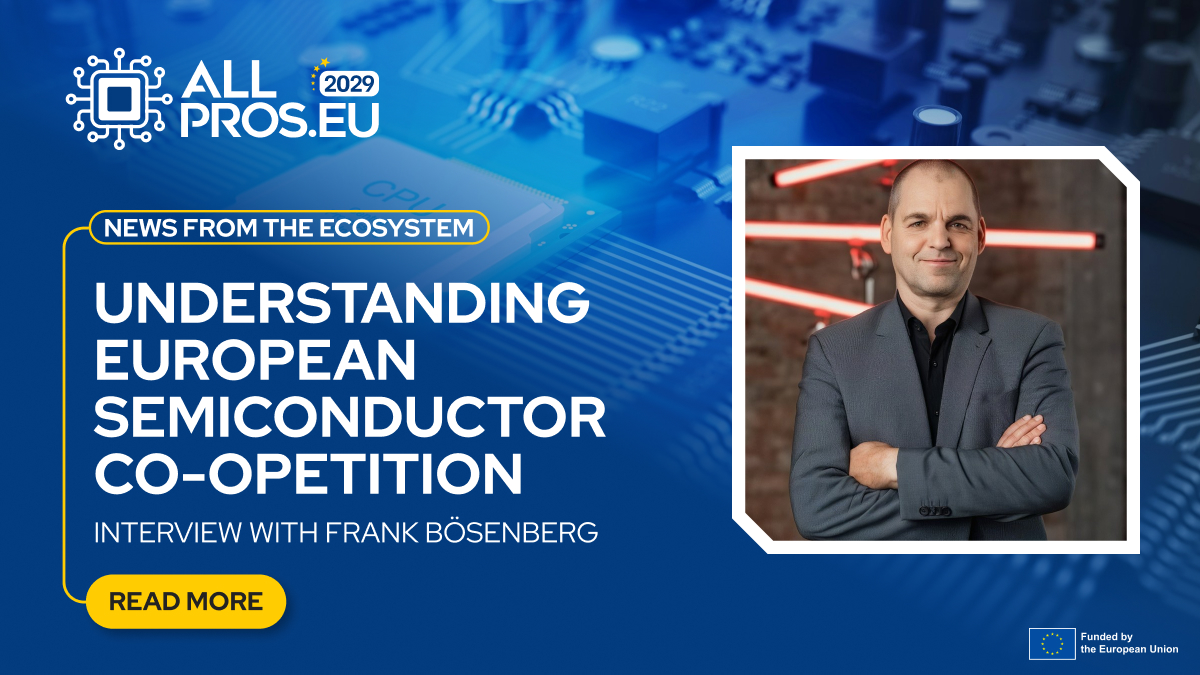
Understanding European semiconductor co-opetition: an interview with Frank Bösenberg
The development of a competitive industrial ecosystem is a gradual process, shaped by the interaction between economic interests, institutional choices and the relationships established among different actors. In the semiconductor sector, where technological progress is closely intertwined with geopolitical considerations and global supply chains, the ability to develop a shared vision has become particularly relevant to Europe’s industrial future.
How can regional experiences contribute to this broader ambition? And what conditions are needed to turn individual industrial strengths into a more cohesive European ecosystem?
We discussed these questions with Frank Bösenberg of Silicon Saxony, exploring the role of cooperation, the value of manufacturing and the importance of ensuring that Europe’s semiconductor community can speak with a stronger, more coordinated voice.
Building trust across industrial boundaries
Strong industrial ecosystems require continuity and long-term commitment. Drawing on the experience of Saxony, Bösenberg recalls how the development of its semiconductor sector has been shaped by decades of support and collaboration.
“Silicon Saxony wasn’t built overnight. It’s a story that lasts for at least 30 years, depending on how you tell it, even more than 60.”
Another important factor is the relationship between cooperation and competition. Bösenberg describes this balance as co-opetition: companies may compete in the market while sharing an interest in strengthening the ecosystem in which they operate. Independent organisations can help sustain this dialogue, bringing stakeholders together while retaining the freedom to address common challenges openly.
More generally, cooperation can also benefit from a common identity. A recognisable territorial brand helps companies, research organisations and other stakeholders see themselves as part of a wider industrial community, where what matters is creating a shared reference point that gives visibility to the ecosystem and strengthens the connection between its participants and the territory.
Recognising manufacturing as a source of innovation
Discussions about technological progress often focus on research, design and start-ups, leaving the contribution of manufacturing less visible. Bösenberg challenges this perspective: factories can become important environments for innovation when connected with research centres, start-ups and external technology providers. This exchange, commonly associated with open innovation, allows new ideas to enter established industrial settings and is relevant across manufacturing sectors.
At European level, effective cooperation also depends on the ability to represent the different interests within the semiconductor ecosystem. Bösenberg highlights the Silicon Europe Alliance, a network of cluster organisations that places particular emphasis on representing SMEs.
“The Silicon Europe Alliance, as a network of cluster organisations, sees itself also very much as the voice of the SMEs.”
While larger companies often have direct channels to represent their interests, smaller businesses can benefit from collective structures. The Industrial Alliance for Semiconductors offers another space for dialogue, bringing together different stakeholders and facilitating exchanges with the European Commission.
Semiconductors are essential to everyday life, yet their strategic importance can be difficult to communicate to the wider public. Bösenberg suggests reversing the usual approach: rather than explaining only what semiconductors make possible, we should consider what their absence would mean.
“Maybe we have to turn it around and show what will happen if there’s no semiconductor industry at all anymore.”
This perspective could help make the implications of Europe’s industrial dependencies more tangible, connecting a highly specialised sector to questions that affect society as a whole.
Shaping Europe’s industrial future
The discussion brings together several conditions for a stronger European semiconductor ecosystem: long-term commitment, trust between industrial actors, a shared identity, recognition of manufacturing as a source of innovation and effective representation at European level.
Bösenberg suggests putting a question to the European semiconductor ecosystem: can we imagine a Europe that no longer produces its own food and depends entirely on imports from elsewhere? And, if we can recognise the risks of such a scenario, why should we consider semiconductors any differently?
“Semiconductors are as important as food. What happens if we have to import all of it?”
It is a question that goes beyond the semiconductor industry itself, inviting stakeholders to reflect on Europe’s industrial resilience and the long-term consequences of its strategic choices.
As the Industrial Alliance enters a new phase, with its renewed governance structure, this is a question worth bringing to the table.
If you want to contribute to shaping the next chapter of the EU semiconductor future, consider joining the Industrial Alliance for Semiconductors.
